
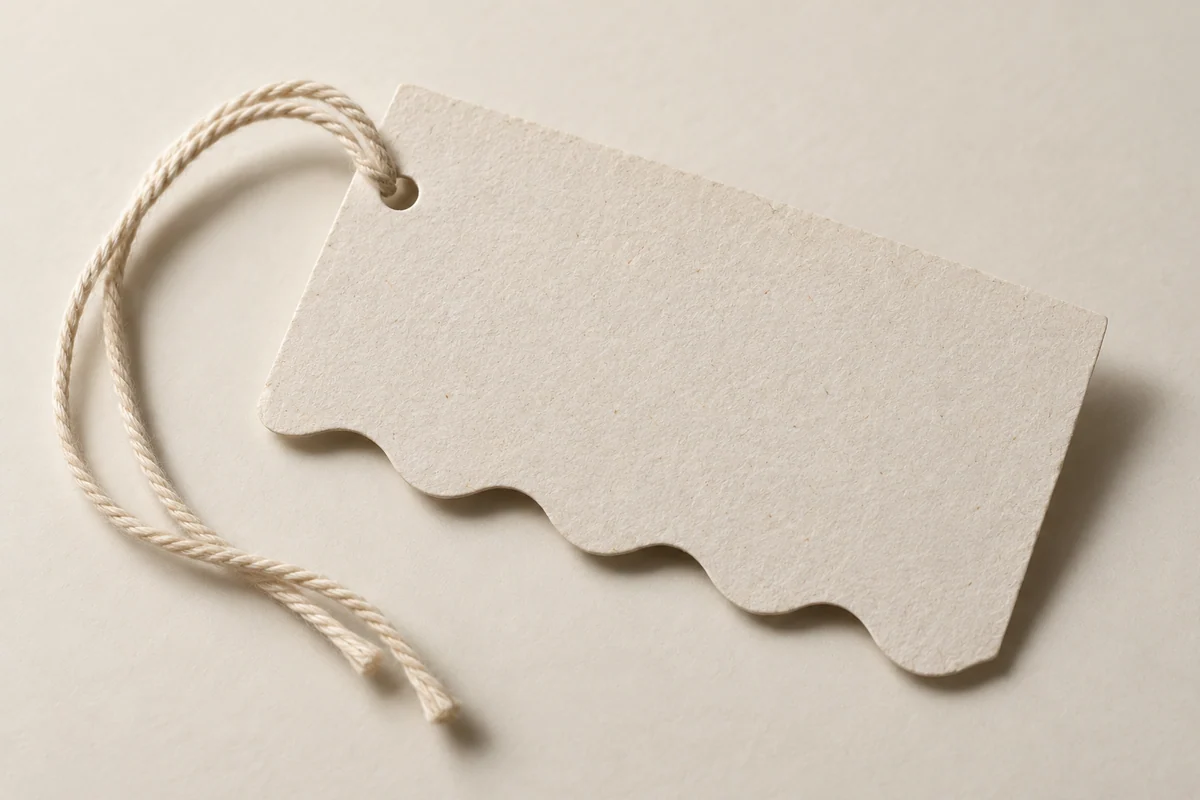
Scalloped wave edge
Wave Swing Tags
A wave tag replaces one or both straight edges with a scalloped curve, which softens the outline without changing how the tag hangs.
- In stock online. Swing tags are configured and ordered online from one tag; briefs for several designs or very large runs can also be quoted through the Custom Tag Builder.
- Free UK delivery. Standard online orders are delivered free to one UK address.
- Free reprint or refund if faulty. Report faulty, damaged or incorrect tags within 30 days of delivery and we reprint them or refund you in full, with free return postage if a return is needed. Because every order is printed to your specification, change-of-mind returns are not accepted. Your statutory rights are not affected.
- Online orders arrive 2–6 working days after artwork approval
Order online
Customise your Wave Swing Tags
Choose the size, shape, card, printing, finish and quantity. The price updates as you change each option.
- Format
- Die-cut wave edge
- Use
- Beauty, artisan and childrenswear
- Material
- Uncoated or textured card
- Artwork
- Upload when ready
Description
Wave Swing Tags prices by quantity
Wave Swing Tags at 85 × 55mm on coated one side 350gsm card, printed full colour on one side, all-inclusive with free UK delivery. Other sizes, cards and finishes are repriced in the order panel; quantities in between pay the rate of the quantity below, and runs above 10,000 tags are quoted.
| Quantity | Price |
|---|---|
| 1 tag | £0.59 |
| 100 tags | £68.00 |
| 250 tags | £96.00 |
| 500 tags | £138.00 |
| 1,000 tags | £198.00 |
| 2,500 tags | £365.00 |
| 5,000 tags | £595.00 |
A product-specific format
Wave Swing Tags for product presentation
Wave Swing Tags give product teams a dedicated format for the information and presentation requirements of the item being sold. The specification should begin with the product it will be attached to, then account for the information the tag needs to carry.
Use the form to record the final size, card direction, print sides, finishing and attachment for wave swing tags. This keeps the practical decisions together before artwork is supplied or confirmed.
Tag anatomy
Wave Swing Tags: parts of the tag
Wave Swing Tags start at 85 × 55mm on coated one side card. Each numbered part of the diagram is a choice you can change in the order panel.
- CardCoated one side, 250gsm to 1200gsm, with 4 other cards in the order panel.
- Front print areaLogo and brand name, printed full colour, in one to three colours or a Pantone match.
- Product detailsPrice, size, barcode, QR code or care notes, below the logo or on the back when the tag is printed on both sides.
- Bleed3mm of artwork past every trim edge, so colour runs cleanly to the cut.
- Hole and eyelet3mm drilled hole as standard, or 5mm with one of 4 metal eyelet colours.
- AttachmentChoose black lock string, white lock string, black elastic loop, white elastic loop and more, or no string.
Where this format fits
Wave Swing Tags uses
Beauty and skincare
The softened edge suits cosmetics ranges that avoid hard geometry elsewhere in their packaging.
Childrenswear
A wave edge reads as friendly without resorting to a novelty silhouette.
Artisan food and preserves
Scalloped tags echo the label shapes already common on jams, honey and preserves.
Gift and stationery ranges
The shape does the decorative work, which lets the printing stay minimal.
Additional information
Build the specification
Wave Swing Tags specification
- Pitch of the scallop
- The wave is defined by how many curves run along the edge and how deep each one cuts. State both, because a shallow six-wave edge and a deep three-wave edge are different products.
- Printable area shrinks unevenly
- A straight margin no longer works. The safe area has to follow the deepest point of the curve, which costs more room than people expect.
- Cutting form
- A wave outline needs a die. That is a fixed tooling cost per shape, so it is absorbed by a longer run and dominates a very short one.
- Hole against the curve
- Keep the punched hole clear of a scallop trough, or the remaining board between hole and edge becomes the weak point.
Artwork and file guidance
Prepare the artwork
Plan the finished format before export
Draw the final wave as the dieline and keep bleed running beyond every crest and trough. A straight rectangular bleed box does not protect the curved edge from a white sliver.
Set the safe margin from the deepest trough, then check the hole against the nearest curve at finished size. Supply the cut path on its own named layer rather than folding it into the printed artwork.
Continue your research
Further swing tag guidance
Questions and answers
Questions before you order
Wave Swing Tags FAQs
Does a wave edge cost more than a rectangle?
Yes, because it needs a cutting form rather than a straight guillotine cut. The tooling is a one-off per shape, so the difference per tag falls away as the run gets longer.
How much printable area do I lose?
More than the drawing suggests. The safe margin has to be measured from the deepest trough of the wave rather than from the outermost point, so plan the layout against the trough.
Can the wave run on all four edges?
It can, but it rarely reads well. Most wave tags use the scallop on one or two edges and keep the rest straight so the tag still stacks and hangs predictably.