For shirting and formalwear
Custom Shirt Tags
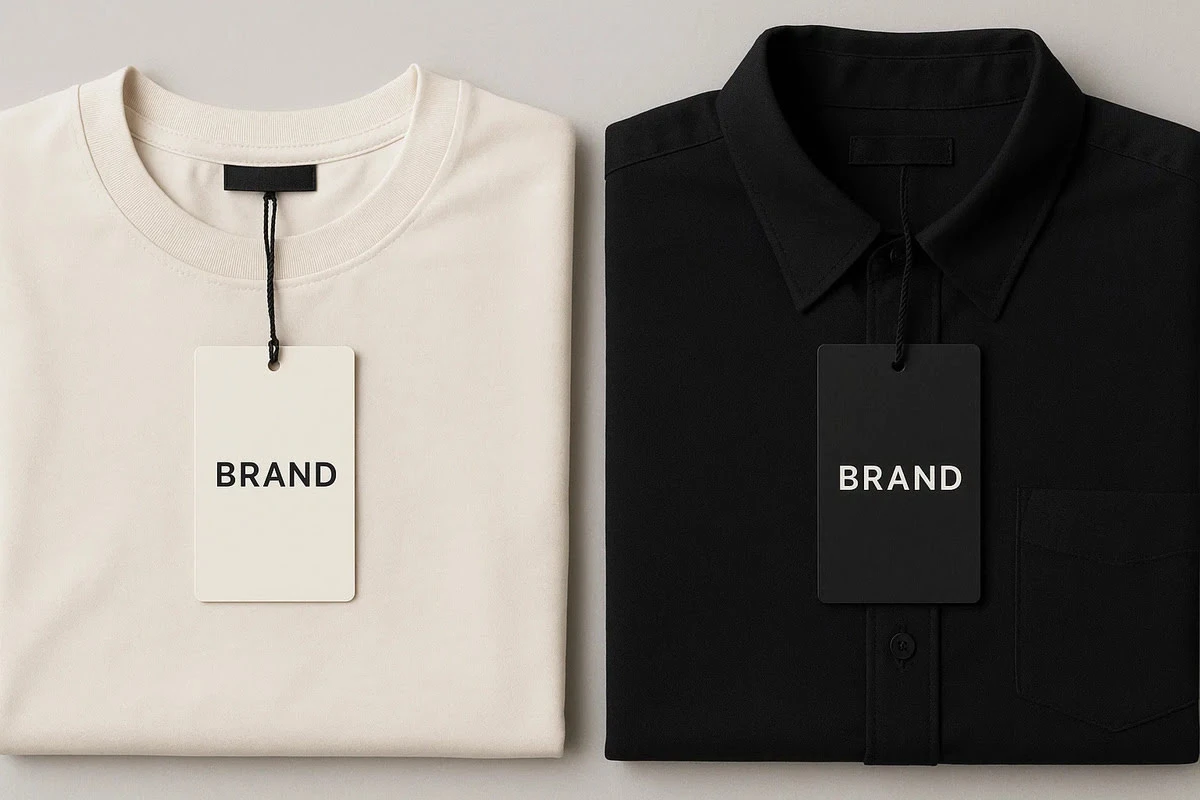
A shirt tag hangs at the collar or placket where it is seen first and handled most, so size, fibre and care information has to read cleanly at a glance.
- In stock online. Swing tags are configured and ordered online from one tag; briefs for several designs or very large runs can also be quoted through the Custom Tag Builder.
- Free UK delivery. Standard online orders are delivered free to one UK address.
- Free reprint or refund if faulty. Report faulty, damaged or incorrect tags within 30 days of delivery and we reprint them or refund you in full, with free return postage if a return is needed. Because every order is printed to your specification, change-of-mind returns are not accepted. Your statutory rights are not affected.
- Online orders arrive 2–6 working days after artwork approval
Order online
Customise your Shirt Tags
Choose the size, shape, card, printing, finish and quantity. The price updates as you change each option.
- Format
- Small portrait or folded
- Use
- Collar size, fit and fibre
- Material
- Silk, uncoated or textured
- Artwork
- Upload when ready
Description
Shirt Tags prices by quantity
Shirt Tags at 50 × 75mm on coated one side 350gsm card, printed full colour on one side, all-inclusive with free UK delivery. Other sizes, cards and finishes are repriced in the order panel; quantities in between pay the rate of the quantity below, and runs above 10,000 tags are quoted.
| Quantity | Price |
|---|---|
| 1 tag | £0.42 |
| 100 tags | £42.00 |
| 250 tags | £58.00 |
| 500 tags | £79.00 |
| 1,000 tags | £118.00 |
| 2,500 tags | £215.00 |
| 5,000 tags | £365.00 |
Collar and placket tags
Shirt tags for collar size, fibre and care
Shirt tags hang at the collar or placket, where a customer looks first, so collar size, fit and fibre content need to read at a glance. A folded tag suits shirts with a longer care or fabric story; a flat tag is enough for size and price.
Care symbols must stay legible at small sizes, so keep them simple and dark on a light ground. If the tag should match an existing sewn-in label, send the label colours and typeface with your specification.
Tag anatomy
Shirt Tags: parts of the tag
Shirt Tags start at 50 × 75mm on coated one side card. Each numbered part of the diagram is a choice you can change in the order panel.
- CardCoated one side, 250gsm to 1200gsm, with 4 other cards in the order panel.
- Front print areaLogo and brand name, printed full colour, in one to three colours or a Pantone match.
- Product detailsPrice, size, barcode, QR code or care notes, below the logo or on the back when the tag is printed on both sides.
- Bleed3mm of artwork past every trim edge, so colour runs cleanly to the cut.
- Hole and eyelet3mm drilled hole as standard, or 5mm with one of 4 metal eyelet colours.
- AttachmentChoose black lock string, white lock string, black elastic loop, white elastic loop and more, or no string.
Where this format fits
Shirt Tags uses
Collar size identification
The collar measurement is the single most-checked number on a shirt, and the tag is where a customer looks for it first.
Fibre and weave detail
Poplin, twill, oxford and cotton counts justify the price, so the tag carries the detail that explains it.
Care and pressing guidance
Iron temperatures and wash guidance sit naturally on an inner panel of a folded shirt tag.
Fit range navigation
Where one shirt comes in several fits, the tag separates them on the rail without the customer opening the packaging.
Additional information
Build the specification
Shirt Tags specification
- Size at the collar
- Shirt sizing is a collar measurement rather than a generic small or large, so the number has to be unambiguous and large enough to read on a packed rail.
- Format and panel count
- Fibre content, care symbols and fit notes rarely fit on one face. A folded tag buys two more panels without making the hanging tag any bigger.
- Where the tag hangs
- A shirt tag usually hangs at the top button or the collar band, which puts it directly in the customer’s eyeline and against a pressed surface.
- Surface and print detail
- Silk and lightly coated boards hold small type and fine rules cleanly, which matters when care symbols are printed at only a few millimetres.
- Fit naming
- Slim, classic and tailored mean different things between brands. Whatever the range calls them, the tag has to use the same words as the website and the sewn label.
- Quantity and repeat
- Shirting reorders in the same sizes season after season, so a repeat-friendly specification is usually worth more than the lowest one-off price.
Material, print and finish
Choose the details around the product
Shirt Tags format alone does not determine the finished hang tag. The card, print, finish and attachment should be chosen together with the product context and artwork.
- Stock: Silk and uncoated boards both suit shirting. Silk keeps small care symbols crisp; uncoated gives a softer, more tailored feel in the hand.
- Printing: Formalwear tags are usually restrained, with one colour and a blind deboss doing more than a full-colour design would.
- Folding: A short fold adds two panels for fibre and care detail while keeping the visible front face clean.
- Attachment: Fine cotton cord and clear nylon loops both suit shirting, where a heavy jute twine would look out of place.
Artwork and file guidance
Prepare the artwork
Plan the finished format before export
Keep care symbols and fibre content at a legible size, dark on a light ground. On a folded tag, put the collar size on the front where it is seen without opening the tag.
If the tag matches a sewn label, reuse the label's typeface and colours so the two read as one system.
Continue your research
Further swing tag guidance
Questions and answers
Questions before you order
Shirt Tags FAQs
Should a shirt tag be folded or flat?
Folded, if fibre content and care symbols both need to appear. A short fold adds two panels without increasing the hanging size, which is the usual reason shirting tags fold and denim tags do not.
How small can care symbols be printed?
Down to a few millimetres on a silk or coated board, which holds the outline cleanly. On uncoated stock the ink spreads slightly, so the symbols need opening up a step.
Can the tag match an existing sewn label?
Yes. Supply the label artwork and the tag can follow the same typeface, sizing language and fit names so the two do not contradict each other.
Where should the tag hang on a shirt?
Usually the top button or the collar band. Both keep it visible while folded, but the collar band suits a heavier tag because it takes the weight better than a button.