
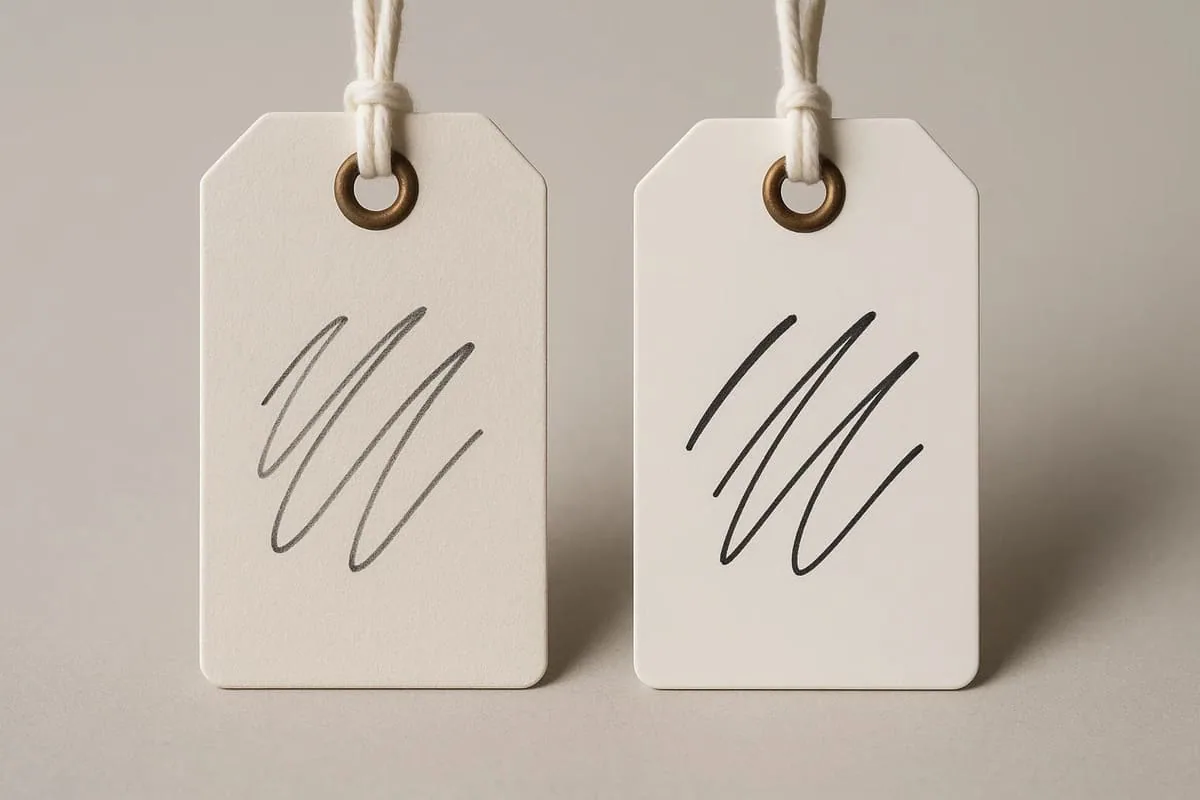
Swing Tag, Hang Tag and Label

Swing tag and hang tag comparison

For most UK buying and printing briefs, “swing tag” and “hang tag” describe the same removable printed product tag. “Swing tag” is common British terminology, while “hang tag” is widely used internationally. Product function, dimensions, material and attachment matter more than the wording used to name it.

Why both terms are used

The names come from how the label is attached and displayed: it hangs or swings from a product rather than being permanently sewn, glued or printed onto it. Clothing, jewellery, gifts, furniture and packaged goods may all use the same basic format even though each trade describes it differently.

Related terms and practical differences

Swing ticket
Often used in fashion and retail for a printed price or product-information ticket. It may include a barcode or detachable section.
Clothing label
Can mean a removable card tag or a permanent woven or printed label. State which construction you need.
Price tag
Describes the information purpose. It may be a standard swing tag, adhesive label or perforated retail ticket.
Bottle neck tag
A product-specific format that hangs over or attaches around the neck of a bottle.

When people say “label” they may mean two different things

This is the term that causes the most confusion in a brief, because it covers two products that are made in completely different ways. A printed card tag that hangs from the product on string is what most people mean by a swing tag label or a hang tag label — it is the same item this site prints. A woven, satin or sewn-in label is a textile component stitched into a garment during manufacture, and it is a different supply chain entirely.

Swing tag label / hang tag label
A printed card tag attached by string, ribbon or an eyelet, removed by the customer after purchase. Interchangeable with swing tag and hang tag.
Hanging label
The same removable card tag, named after how it attaches rather than what it carries.
Woven or sewn-in label
A fabric component stitched into a seam or neckline, intended to stay with the garment for its life. Not a printed card tag, and produced by a textile label maker rather than a printer.
Adhesive or product label
A self-adhesive sticker applied to packaging or to the product itself. Useful where nothing can hang, but it cannot be removed cleanly from most finished surfaces.

How to write an unambiguous brief

  • Give the finished size and shape in millimetres.
  • State whether one or both sides are printed.
  • Identify the card or describe the required feel and durability.
  • Mark the hole, fold, perforation and safe artwork areas.
  • Specify loose string, supplied loops or fully attached stringing.
  • List any variable prices, barcodes, SKUs or multiple designs.

Choosing a page or product route

Use product pages when you are ready to specify a commercial tag. Use terminology and artwork guides when you are still deciding format or preparing files. This keeps the buying decision separate from general definitions and helps avoid ordering the right name with the wrong construction.

Decision context

Use construction terms to remove ambiguity from the brief

Swing tag and hang tag commonly name the same removable printed product label, but related phrases can carry different expectations. A swing ticket may emphasise retail information; a clothing label may mean a permanent sewn component; a bottle-neck tag describes a product-specific shape.

Do not rely on the noun alone. State the finished dimensions, shape, printed sides, stock, hole or fold position and attachment. Describe the information role—brand, price, size, care, barcode, promotion or product story—so the supplier can understand the intended function.

Use photographs as visual context, then identify which attributes should be reproduced. A reference cannot reveal exact material, scale, colour values or finish. Mark any foil, lamination, perforation, relief or die-cut path in the artwork and written specification.

For international teams, keep one approved term and one technical description in the job record. This prevents regional wording from producing duplicate or conflicting requests. The correct result comes from the shared construction and approved proof, not from choosing one synonym over another.