
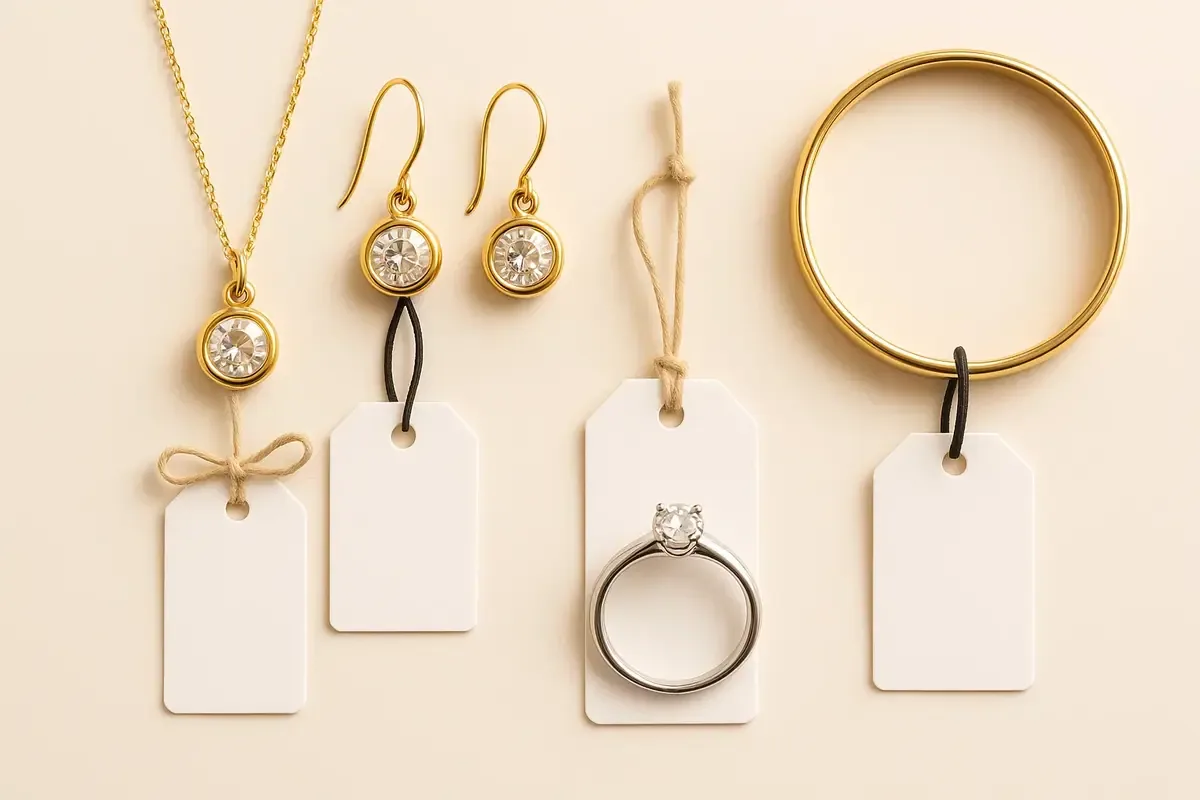
Elastic loops
Elastic can stretch around products without tying a knot and may speed application. Specify relaxed length, stretched requirement, colour and connector style. Excess tension can distort a light tag or mark a delicate product.
Ball chains
Ball chain opens and reconnects through a small coupling. It can suit luggage, accessories, samples and products where the tag may be removed and reattached. Chain diameter, finish, cut length and connector all affect use.
Selection checklist
- Test the closure on the real attachment point.
- Confirm the hole is large enough but not visually dominant.
- Check tag weight and edge strength.
- Assess scratching, snagging or colour-transfer risks.
- Decide whether loops or chains arrive loose or pre-attached.
- Allow enough length for staff to apply the tag efficiently.
Decision context
Choose a removable attachment by fit and handling
Elastic loops stretch around a product or closure; ball chains open and reconnect around a handle, eyelet or fixture. Measure the attachment path and identify the required opening method. The same nominal length can sit differently depending on product diameter, stretch and where the tag rests.
Use elastic only where tension will not distort or mark the product. Check knots, connectors and metal surfaces against jewellery, polished goods, coatings and delicate textiles. A secure retail attachment can still be unsuitable if it catches during packing or is difficult for staff to apply repeatedly.
Coordinate loop or chain thickness with drill-hole and eyelet dimensions. A small hole can bind movement, while an oversized opening may look uncontrolled. Tag size, board weight and hole margin affect how the complete assembly hangs and withstands handling.
Record material, colour, cut or loop length, connector, quantity and supply condition. Test a production-equivalent sample on the real item and through the intended packing process. The quote should state whether attachments arrive loose, pre-looped or fitted to each printed tag.